World Cup Drives Prediction Market Boom as June Trading Volume Doubles

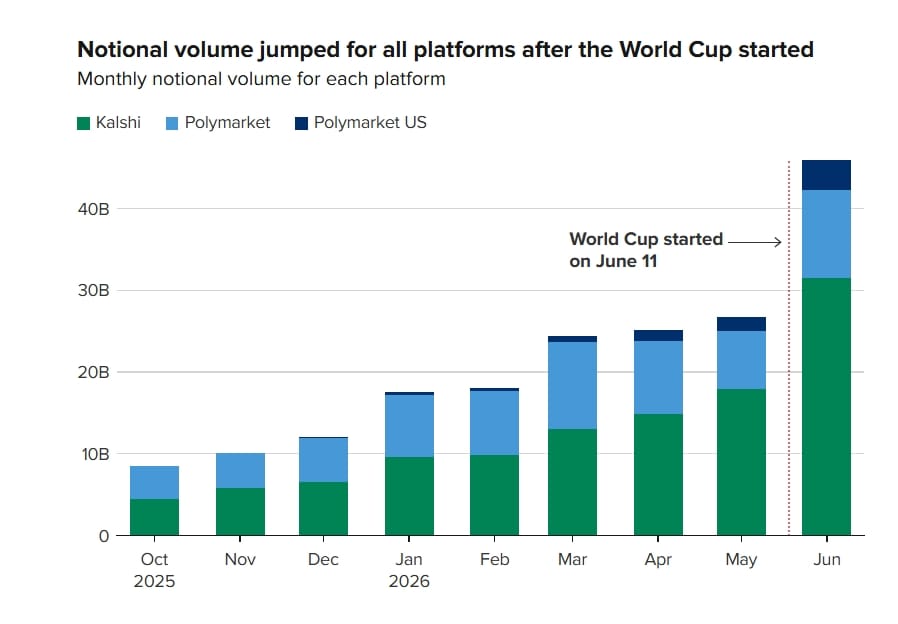
Trading activity surged throughout June as bettors and traders flocked to markets tied to the World Cup, helping push the industry to new highs and attracting major financial players eager to capitalize on the growing sector.
On Polymarket's U.S. platform alone, monthly trading volume climbed to more than US$3.5 billion in June, nearly doubling from US$1.77 billion the previous month. The jump underscores just how powerful live sports—particularly a global event like the World Cup—can be in driving participation.
The growth wasn't limited to established operators.
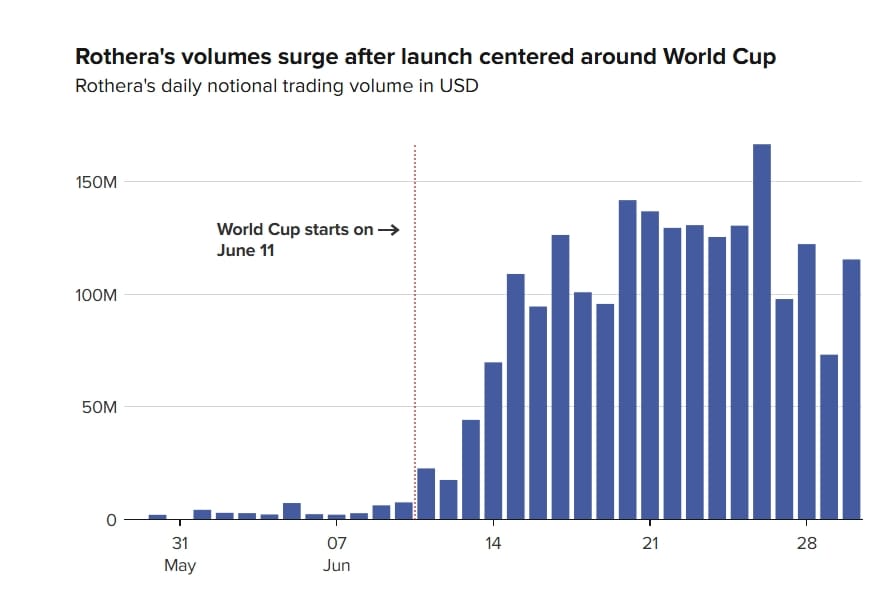
Rothera, a new prediction market backed by Susquehanna International Group and Robinhood, recorded approximately US$2 billion in notional trading volume during its first month of operation. According to Bank of America, the newcomer already accounts for roughly 7% of the U.S. prediction market.
That rapid adoption was helped by Robinhood's decision to begin routing select World Cup prediction contracts from its brokerage platform directly to Rothera, giving millions of retail users easy access to event-based trading.
The data suggests the World Cup has become more than just a betting event—it's acting as a catalyst for mainstream adoption of prediction markets.
Unlike traditional sportsbooks, prediction markets allow users to trade contracts whose prices continuously adjust as new information becomes available. That has created an entirely different experience during the World Cup, where odds move in real time following every goal, injury and surprise result.
We've already seen dramatic examples throughout the tournament.
Mexico's championship probability more than tripled after its strong start. Argentina climbed from the middle of the pack to become one of the tournament favorites. Meanwhile, disappointing performances from Spain, Portugal and Brazil erased billions of dollars in implied championship probability almost overnight.
These rapid price movements have highlighted a key distinction between sportsbooks and prediction markets: participants aren't simply betting outcomes—they're actively trading information.
The June figures also suggest institutional interest in the sector is accelerating.
Robinhood's partnership with Rothera demonstrates that traditional financial firms increasingly view prediction markets as a legitimate trading product rather than a niche betting market. Combined with Polymarket's record volumes, the World Cup has provided perhaps the strongest evidence yet that sports could become the industry's biggest long-term growth driver.
With the tournament entering the knockout rounds—where every match carries greater significance—trading activity could remain elevated through the final.
If June's numbers are any indication, the World Cup may be remembered not only for what happened on the pitch, but also as the month prediction markets entered the financial mainstream.